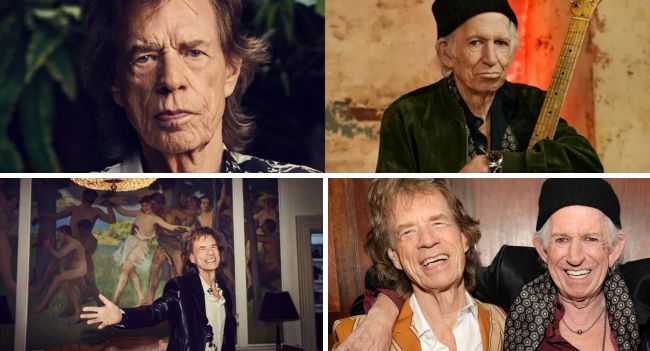
At 82,Mick Jagger and Keith Richards are as vital and creative as ever. With a new Rolling Stones album just out, the yin and yang of rock open up about touring, AI and why their partnership still works
Under a poolside garden canopy in West London, Mick Jagger offers me a tongue-in-cheek choice as we sit down: “Should I be polite and English or shall I be rude and New York-like?”
The English rocker, who lived in New York for 18 years and was knighted in 2003, is smirking — but one gets the impression he could readily slide into either mode. The Rolling Stones frontman can code switch in a Jumpin’ Jack flash, talking as comfortably about physics and aviation as pop stars and bluesmen.
Forty-eight hours later, when I sit down with Keith Richards in a Manhattan jazz club for a separate chat, he offers no such options: Keef is simply Keef. If the 82-year-old Jagger is polished and detail-oriented (he gives feedback on the placement of our chairs relative to the camera filming our conversation, and notes that an overhead airplane must be “old-fashioned” because he can hear its propeller), Richards, also 82, is relaxed and slyly mischievous, full of rumbling chuckles and one-liners about everything from smartphones (“I feel Toytown eludes me”) to his grandchildren (“there’s these little creatures rolling around that sort of vaguely remind you of somebody”).

They may share an obsession with American blues and R&B, but the Glimmer Twins are far from identical. And since their debut recording 63 years ago, that oil-and-water alchemy has fueled the greatest rock’n’roll band in the world. While the Stones started out as a rhythm and blues covers band steered by guitarist Brian Jones, the songwriting tandem of singer Jagger and guitarist Richards (which began when then-manager Andrew Loog Oldham demanded they write their own material to keep pace with The Beatles) soon became the Stones’ not-so-secret weapon. As Chuck Berry acolytes, Jagger and Richards mastered the art of biting rock brevity, releasing a string of genre-hopping singles (five of their eight Billboard Hot 100 chart-toppers came between 1965 and 1969) that made them stars on both sides of the Atlantic and inspired a generation of rockers (garage, punk, country and beyond) from Croydon to California.
But success came with casualties. In July 1969, Jones was found dead in his swimming pool at 27, weeks after a meeting with Jagger, Richards and drummer Charlie Watts about his drug abuse led to him leaving the group. Months after, a woman was fatally stabbed during the band’s concert at Altamont Free Festival — later cited as the moment when the optimism of the ’60s came crashing down. Tumult continued in the ’70s. Mick Taylor, Jones’ replacement, was in turn supplanted in 1975 by Ronnie Wood (who has remained a member since). The group weathered drug-related arrests, went into tax exile from the United Kingdom and filed suit against former manager Allen Klein for allegedly fraudulent practices. (The band settled with Klein in 1984.)
Those legal headaches didn’t quash creativity or commercial success. If anything, the “me” decade is when the Stones codified their distinctive style — sleazy, bluesy and boozy rock, presided over by Jagger’s insouciant sneer and Richards’ roguish grin — on landmark albums including Sticky Fingers (1971), Exile on Main St. (1972) and Some Girls (1978). On the business side, the launch of the now-defunct Rolling Stones Records label in 1970 produced the iconic lips’n’tongue logo and signaled the band’s efforts to take control of its recordings, finances and future.
In 1986, a full nine years before winning a competitive Grammy, the Stones received a lifetime achievement award from the Recording Academy. But the elder statesmen of rough-and-tumble rock weren’t done blazing trails. Sniffing out opportunity, the Stones partnered up with fragrance maker Jovan on their 1981 tour, receiving several million dollars to offset production costs. The 1989-90 Steel Wheels tour, promoted by the legendary Michael Cohl, changed how tours were staged and financed, upping the ante on immersive stage designs and establishing new norms for the touring biz (corporate sponsors, merchandise aplenty) that continue to this day. From then on, the Stones remained a road juggernaut, grossing $2.9 billion and selling 28.9 million tickets dating back to Steel Wheels, according to Billboard Boxscore. The band’s 2024 trek alone earned $235 million and sold 848,000 tickets across 18 shows, marking the band’s fifth consecutive tour to average at least 45,000 tickets per night. The days of manager drama are behind them, too: Joyce Smyth, who entered the group’s orbit as part of its legal team, has been the band’s manager since 2010. (Jane Rose manages Richards, and Pia Squillino serves as Jagger’s business executive.)
But despite their plentiful live shows, there’s been a comparative dearth of new Stones songs in the 21st century: 2023’s Hackney Diamonds was the first Stones album of original material since 2005’s A Bigger Bang. Although the band had been knocking around material for years, it needed a push over the finish line. About a year after Watts died in 2021 at age 80, Paul McCartney suggested while dining with Wood that the band give producer Andrew Watt (now a bit of a studio specialist with veteran rock acts from Ozzy Osbourne to Pearl Jam) a shot. The next day, Wood spoke to Jagger and learned Watt’s name was at the top of a list of producers the frontman was considering. “So we tried this young whippersnapper,” Wood, speaking over the phone from London, recounts the week after I meet Jagger and Richards. According to the guitarist, who joined the band 51 years ago but remains its “newest” member, Watt helped keep them on task: “Keith would say, ‘I’ll do my guitar next week.’ ‘No, you’ll do it now.’ ” The producer’s deft musicianship ensured the Stones took him seriously. “He’s a great guitarist. He can play my parts better than I can,” Wood jokes.
Hackney Diamonds debuted at No. 3 on the Billboard 200, becoming their 38th top 10 set, and it later won the Grammy Award for best rock album. And this time, they didn’t wait 18 years for a follow-up.

Drawing on unfinished material from the Hackney Diamonds sessions, the Stones reunited with Watt for Foreign Tongues, a 14-track album that dropped July 10 on Polydor/Capitol, their label home since the 2016 covers album Blue & Lonesome. Boasting low-key guest spots from McCartney, The Cure’s Robert Smith, Red Hot Chili Peppers’ Chad Smith and Bruno Mars, Foreign Tongues pairs pointed, often political lyrics with ass-shaking rock (“Mr. Charm,” “Divine Intervention”), Chicago blues (“Rough and Twisted”) and country pastiche (“Ringing Hollow”).
“Mick is very focused on the grooves, the BPM, the chord movement, the accents,” says Watt, 35. “Keith is able to weave poetry out of that — taking something Mick started and making a riff everyone’s going to hang onto, a melodic phrase so catchy it becomes the hook of the song.” It adds up to a robust, potent album that punches harder than its predecessor and slaps down the idea that aging artists need to be nostalgic.
Even on different sides of the Atlantic, the duo’s yin-yang chemistry is palpable. Fielding similar questions, Jagger and Richards start from disparate places but frequently arrive at simpatico conclusions; they are sublimely mismatched.
“They’re absolutely incredible together,” Watt says of their in-studio chemistry. “There’s no Mick song that’s not better with Keith in it, and there’s no Keith song that’s not better with Mick in it. They complete each other. It’s unbelievable to watch and to learn from. They build and they play to each other’s heartbeats, and the roof leaves the building.”
How much of Foreign Tongues grew out of the Hackney Diamonds sessions?
Mick Jagger We had, from Hackney Diamonds, three songs we didn’t put on purposely, because we knew we wanted to save them. We always planned that we were going to do [another] album pretty quick.
Keith Richards I feel like Foreign Tongues is a continuation of Hackney Diamonds — not so much songs as the energy and the feel of it. As happens with Mick and me occasionally, we don’t see each other for a while. Then somehow when we get together and say, “Well, what have you got?” — “Oh, that bit fits with this.” In a way, we’re writing the same song without knowing it on the other side of the globe.
Jagger Keith did a really nice riff on [“Mr. Charm”] that was better than the one I’d originally written, which is his job: to do my riff, only better.
How does Ronnie fit into it?
Richards Ronnie listens with an eagle ear, and then suddenly comes up with, “What if I do this?” Perfect. I call it the ancient form of weaving — that’s what we do. That’s also, to me, the other fun part of it — I don’t know what Ronnie is going to come up with. You’re watching this thing grow in front of your ears.
There’s a bite to a lot of these songs — where does that come from?
Richards That’s a tough one to answer. At different times in my career I could give you very different answers. Energy — I don’t know whether it’s a matter of enthusiasm, and you go through waves of this. I think a lot of it also had to do with the fact that we really wanted to get this rhythm section of Steve [Jordan, who subbed for Watts on the band’s 2021 tour and currently serves as its drummer] and Darryl [Jones, the bassist who began working with the band in 1993] recorded as the Stones. Because it’s a hell of a thing to lose Charlie Watts. Thank God that Charlie and Steve were like that (Crosses fingers.) so it was never any real hassle. Charlie Watts said, “If I’m not there, put Steve in.” So we were sort of under orders. It was important just to get this version of the Stones down on record.
Jagger We had a good track with Charlie [“Hit Me in the Head”] and we’ve got other tracks with Charlie. I keep reading this is Charlie’s final appearance — well, we’ve got other tracks with Charlie.

What is Watt’s role in the studio?
Richards He’ll say, “Let’s try this one, let’s throw a piano on here, see what happens.” Basically, he becomes part of the band. A good producer is usually pretty much the other, unseen member of the band.
Jagger Andy and I work together well, because we balance each other out.
As on Hackney Diamonds, Paul McCartney pops in for a guest spot, playing bass on “Covered in You.” He and John Lennon co-wrote the Stones’ second single, “I Wanna Be Your Man.” Now, six decades later, he’s in the studio with you.
Richards The Beatles and the Stones. Paul sounds like he’s always missed not being in a band, I think, ever since The Beatles broke up. He just loves that camaraderie, that way of doing things. And he’s great fun to play with. We do go back a long way.
Jagger Paul was next door making the album he currently has [this year’s The Boys of Dungeon Lane], which is a very good album. It’s great. We called Paul in to do two numbers one day because we didn’t have a bass player, per se. For Paul, he has to write the bass line, but this is a very different song to the one he did on Hackney Diamonds, perhaps a bit more difficult. Paul really liked the song, anyway.
There are a lot of guests on the album.
Jagger A lot of them don’t do much.
It’s not a big star cameo situation; it’s them coming into your world. Bruno Mars, for instance: How did he end up playing cowbell on “Never Wanna Lose You”?
Jagger Every time we got a guest to come and listen, to hear the album — because we were probably in the premixing stage by then — we put them to work. “You like the song? Go and play something.” That’s what we did with Bruno. “I really love this groove!” “You play percussion, what do you want to play? Go out and do it.”
Robert Smith guests on two tracks. He’s also on Olivia Rodrigo’s album this year. What are your thoughts on her rock music?

“Every time we got a guest to come and listen, to hear the album … we put them to work. ‘You like the song? Go and play something.’ ”
—Jagger
Jagger She’s really good at it. Everyone thought she was a different kind of singer, but there’s quite a few female singers that have made that transition. It’s not a permanent transition necessarily, but the ability to change styles from what you think their original girly pop stuff is — it’s kind of interesting.
What are your songwriting habits like? Do you keep notebooks, record bits on your phone?
Jagger The good thing about writing in a notebook is you have time to think and cross out — you’ve got your crossings-out and corrections. But the advantage of spitting into your phone or your iPad is that you don’t have any censorship between your head and the pen. You’re never censoring it because it’s too quick. It’s just coming out real spitball fast.
Richards There are a lot of notebooks with little cryptic phrases written down that you’re supposed to remember what the hell they meant. And then when you don’t, you go through them and make up a whole new meaning. But yeah, there’s a lot of jotting things down. Songwriting is really observing. It could be just a phrase that somebody mentions across a bar and something clicks — and it’s just a matter of realizing that something’s there.
Keith, your lead vocal on the album, “Some of Us,” is about an amazing woman who has everyone on their knees. Where does a song like that come from — personal experience?
Richards A little bit of that. The fact is the song has been around — there are several other versions that must be at least 20 years old in the making. Where they come from, I don’t know. Whoever she is, she’s lost in the mists of time. (Laughs.)
Is it important to have a Keith lead vocal on each Stones album?
Richards No, it’s not a fetish. It’s just usually I’ve got one or two, and Mick’ll say, “I can’t get around that one, you better sing that.” And other times I say, “This one I’m keeping, I’m going to do this one.” It just depends on the song and whether we need another song or not. It’s not a forced thing — “Where’s my song?” But there’s always one or two that crop up, and Mick says, “This one’s yours.”
The album ends with a Chuck Berry cover, “Beautiful Delilah.” The Stones’ first single was a Chuck Berry cover, too, of “Come On.” I’m guessing if there were a Mount Rushmore of The Rolling Stones’ influences, he would be on it. Who else?
Jagger He definitely would be up there. That’s a good one. I suppose Muddy Waters, Howlin’ Wolf, Jerry Lee Lewis maybe, Little Richard.
Richards Oh, it would have to be Chuck Berry, Muddy Waters, Jimmy Reed, through the harp of Little Walter Jacobs. And then you go through the old litany of the ’50s and ’60s and the Chicago blues roster — John Lee Hooker. An amazing period in time, the ’50s, for the ways of recording.

“Music could do a lot better than just trying to copy itself. After all, it’s pretty simple stuff — this is not Beethoven or Bach, and I’ve no doubt AI can do that, but so what? We want new input.”
—Richards
Jagger We haven’t used tape for ages, but Andy [Watt] wanted to use tape for “Beautiful Delilah.” I said, “What does it matter? If someone listens to it on their phone, they don’t know it was cut on tape — it doesn’t make any difference.” But we cut it on tape and we did it live. That was old style.
Your “In the Stars” video used deepfake technology to show what looks like the Stones of yesteryear performing your 2026 single. What was that like to see?
Jagger We had a lot of fun with that. It’s only the faces of the musicians that are different. They’re not fake people in a fake room; they’re all in a room, really playing together. The musicians are real musicians that look a bit like The Rolling Stones in 1968. The only thing was the faces. So they worked on mine first, and it kind of looked like me, but not really — like one of my children when they were 23 or something. And then I saw Ronnie, and I said to the people working on it, “It looks more like Jeff Beck.” So they had to do a bit extra work.
Richards That’s our brushing with AI. I said, “Very nice. I wish I looked like that now.” But maybe that’s what they’re good for — music videos. Put it in its proper place. It’s a cartoon of me, younger. “Very nice. What’s for breakfast?” Also, the idea of video and music together — I knew it was a disaster way back in the ’70s. You can’t shove the ears and the eyes together and say, “Here it is, look at this.” But that’s the commercial end of the business, and you duck and dive. The [music] video became, for a while, more important than the record — which is where it really screwed it up for me as a viable thing. It was just, “Have you seen the new video?” “No — I just made a record.” But that’s just me being ornery, probably.

Artificial intelligence is the new technological innovation. What do you think about AI in music?
Richards My thoughts are: I’d rather hear something original. Music could do a lot better than just trying to copy itself. After all, it’s pretty simple stuff — this is not Beethoven or Bach, and I’ve no doubt AI can do that, but so what? We want new input. We don’t want more and more copying and synthesizing. At least that’s my point of view. Music is to play around with. Surely there’s enough originality without having to copy nursery rhymes.
Jagger Obviously I don’t want to be imitated by AI, vocally and instrumentally, and the band doesn’t. I don’t want people just putting stuff out there that can sound exactly like The Rolling Stones — I think that’s obviously wrong. If someone wants to make music by AI, go ahead. But it has to be original — you have to have your own input and your own thoughts. There are people who use AI to just make a song from scratch, in the style of The Rolling Stones. If you were any kind of creative person, you wouldn’t do that.
You guys were doing commercial synchs before most major rock bands — you had “Start Me Up” in the Windows 95 launch. At the time, people gave you some grief for that, but now it’s standard practice to have a song in a commercial. Did it bother you guys back then?
Jagger No. We knew we were doing something that was going to become the norm, honestly. Like when we did sponsorship for tours, people said, “What is that?” I said, “Well, it’s going to become the norm.” And this is the total norm now. This is America; this is how it works.
Richards It depends. If you’re going to sell out, it depends how you sell out.
Do you see yourselves touring behind this album? Or perhaps doing a residency?
Jagger I don’t know at the moment, honestly. I would like to tour. I like touring, like going to people. If it can only be a residency, it can only be a residency. But the thing about a residency — the only downside for people is that it’s much more expensive for the further-out people that want to come and see the show.
Richards I know that this is all being kicked around. This year, we just decided, “Look, let’s get the record out, and let’s not rush things.” So I see no reason why next year — I don’t see anything this year, I can’t rush it that much — but I see no reason why next year, good Lord willing, we shouldn’t be able to, as you say, maybe a residency, something. Maybe you find a different way of taking the thing on the road. Bring the road to us. That’s my suggestion.
“Mr. Charm” might be my favorite song on the album. There’s a line in it, “the darkest days of 1916.” Is that a reference to the Battle of Somme in World War I? Mick, are you a history buff?
Jagger Somme or Ypres. I can’t remember which. I am a history buff, but I don’t know why it came to me to throw that in there as a seductive line. (Laughs.) I was just showing off.
What are you reading now?
Jagger It’s not so much a history, it’s an argument between physicists about what happened before the Big Bang. It’s a layman’s thing. The whole argument is, if we accept that the Big Bang happened, which not everyone does, then what did it come from? Did it come from nothing, or what happened before the Big Bang? There are lots of different scientists with different theories about what this could be. It hasn’t been figured out yet, and probably never will.
If you’re not touring or recording, what are you doing on a given day? You wake up, what’s next?
Richards “Wake up” is important. After that, it depends on the weather. If there’s no fixed plans for the day, let’s see where the day takes me. I’m spoiled in that way, that I can basically turn the day on or turn the day off if I wish. Who’s arrived? The grandkids. And we’ll get into that area of life. You get beaten up a lot. (Laughs.) It’s a whole new thing for me. It creeps up on you. You try and get to know them. It’s a fascinating thing — enjoying it very much.
