Our daughter Emma discovered I was sleeping in the guest room during a visit home. She sat on the edge of the bed and asked the question everyone assumes has an easy answer when a long marriage begins to fall apart. “Is there someone else?”
“No,” I said. There was no mistress, no hotel receipt, no secret phone, and no dramatic betrayal I could hold up as proof. My marriage was ending because I had spent years becoming smaller around a man who barely noticed I was disappearing.
Emma asked if I still loved her father. I told her the truth: “I don’t know.” It frightened me more than anger would have, because I had spent years believing love was the one thing in our marriage that could survive anything.
I rented a furnished apartment for six weeks. David hated the idea, not because he thought I would meet another man or because he was suddenly terrified of losing me, but because paying rent when we owned a house seemed irrational to him. When I told him I needed somewhere else to be, he said I was making an emotional decision and expecting him to understand the logic.
“You don’t have to understand,” I said.
He looked at me as if I had spoken another language.
At the apartment, I woke early on my first morning out of habit. No one needed coffee, no shirt needed ironing, no one was asking where a charger or receipt had gone. I lay there listening to rain against the balcony railing and did something I had rarely allowed myself to do.
I went back to sleep.
Soon I started noticing all the small pleasures I had abandoned because David thought they were unnecessary. I wandered through farmers’ markets without lists, sat in coffee shops without a reason, bought yellow tulips for myself, ate breakfast for dinner, and spent forty minutes in a bookstore without buying anything. Nobody asked me what the point was.
When the six-week lease ended, I went home because part of me still hoped distance had changed us. For three days, David was attentive. He bought groceries, carried my suitcase upstairs, and ordered food from my favorite Thai restaurant.
Then we drove to Emma’s for dinner.
I suggested a prettier alternate road. David glanced at the navigation screen and immediately said, “It takes twenty minutes longer. We’re not sightseeing.”
Something inside me closed quietly.
At Emma’s table, David joked that my apartment had been a “six-week vacation from married life.” I corrected him. I told him I had moved out because I was unhappy, and then I asked him to explain why.
He said, “You felt neglected.”
I asked what he had done that made me feel that way.
David’s face tightened. “I’m not doing this at Emma’s table.”
The location changed, so the conversation ended—just as it always did.
A week later, I told him I wanted a real separation.
“For how long?” he demanded.
“I don’t know.”
He said I couldn’t live indefinitely in some emotional waiting room.
The irony was almost unbearable.
I told him I had already found another apartment.
His face changed. “You signed something without talking to me?”
“I’ve been talking to you for years.”
Two weeks later, I moved out.
David still believed I needed time to calm down. He thought eventually I would miss the house, the routines, and the life we had built enough to return.
What he didn’t know was that four months later, on one ordinary drive home from lunch with an old friend, I would discover something far more dangerous to our marriage than anger.
I would discover how peaceful it felt not to be rushing back to him.
He Asked Why I Was an Hour Late. I Finally Realized I Wasn’t Coming Back to Him Anymore.
My husband asked why the drive had taken me an hour longer than necessary.
For the first time in twenty-seven years, I didn’t apologize.
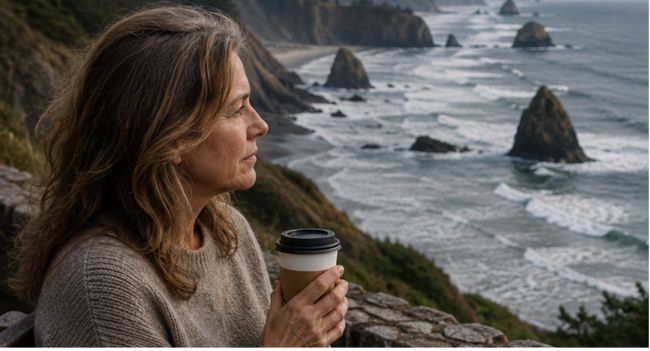
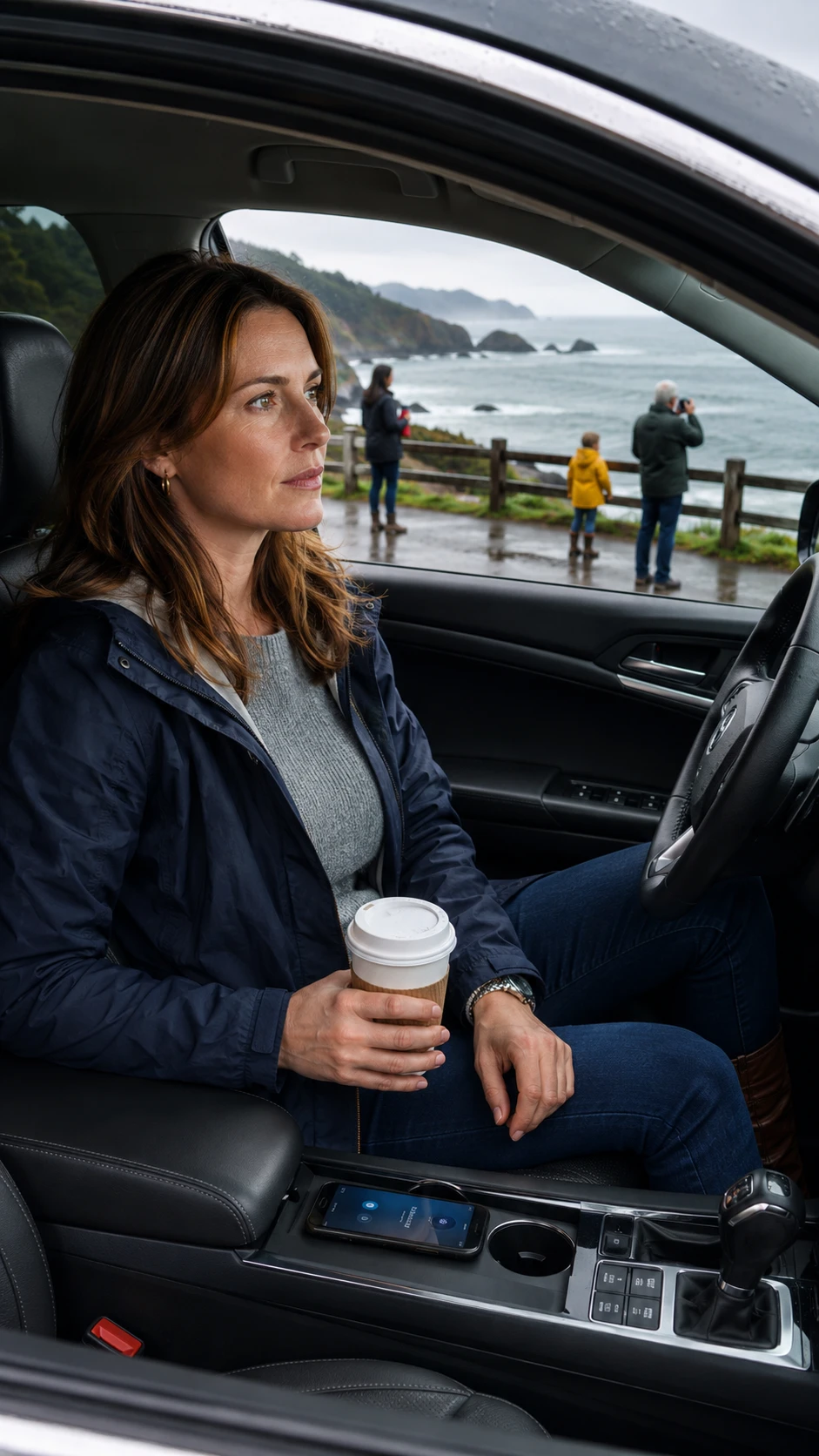
I was sitting in my car at a turnout above the Oregon coast with the windows cracked just enough to let in the smell of salt and wet cedar. A paper coffee cup rested between my hands. Far below me, gray-blue waves folded themselves against black rocks, one after another, with absolutely no concern for anybody’s schedule.
David’s voice came through the speaker.
“Rachel, it’s a two-hour drive. You left almost three hours ago.”
I watched a gull hang motionless in the wind.
“I know.”
There was a pause.
The kind of pause that used to make me hurry to fill it.
Traffic was bad.
I needed gas.
There was construction.
I should have left earlier.
I’m sorry.
For most of my marriage, I had believed every delay required a defense.
Instead, I took another sip of coffee.
David exhaled sharply.
“Well, where are you?”
“Near Cape Lookout.”
“Why?”
I almost laughed.
Not because the question was funny.
Because I suddenly understood how strange my answer was going to sound to a man who had spent nearly three decades believing the only purpose of a road was to get somewhere.
“I wanted to see the ocean.”
Another pause.
“You could see the ocean from the highway.”
“I wanted to stop.”
“For an hour?”
“Yes.”
He sounded genuinely confused.
And strangely, that was the moment something inside me became very still.
Not angry.
Not wounded.
Not desperate to be understood.
Still.
David had called because he needed the garage code for the house we were in the process of dividing after our separation.
But somehow, within thirty seconds, the conversation had become an investigation into what I had done with sixty minutes that no longer belonged to him.
“Rachel,” he said, softer now, “I’m just asking why you’re so late.”
I looked through the windshield.
A woman around my age was standing near the wooden railing with both hands wrapped around a red thermos. Beside her, an older man was photographing the water. A little boy in a yellow rain jacket jumped over puddles while his father pretended not to notice.
Nobody was rushing.
Nobody looked guilty.
And for the first time, neither did I.
“I’m not late, David.”
“What?”
“I said I’m not late.”
“You told Emma you’d be back this afternoon.”
“It is afternoon.”
“I need to get into the garage.”
“I texted you the code twenty minutes ago.”
Silence.
He checked his phone.
“Oh.”
That single syllable carried more truth than our last six months of arguments.
He didn’t actually need me.
He needed me to still be moving toward him.
Toward the house.
Toward the schedule.
Toward the version of myself he understood.
I turned my face toward the ocean.
“I’ll be back when I’m back.”
“Rachel—”
“I’m going to finish my coffee.”
Then I ended the call.
My hand shook afterward.
Not because I was afraid of him.
David had never hit me. He had never thrown things or screamed inches from my face. If someone had asked him whether he was controlling, he would have looked genuinely offended.
He simply had strong opinions about the right way to do things.
The fastest route.
The best parking space.
The proper departure time.
The correct temperature for the thermostat.
The sensible restaurant.
The practical vacation.
The efficient grocery list.
The quickest way home.
And for years, without either of us noticing exactly when it happened, his preferences had become our rules.
I used to think love meant being easy to live with.
So I became very easy.
That afternoon, with the Pacific stretching beyond my windshield and nowhere I urgently needed to be, I began learning something I should have understood years earlier.
Sometimes freedom does not arrive with slammed doors.
Sometimes it begins when someone asks why you are late—
and you finally realize you do not owe them an explanation.
CHAPTER 1 — THE FASTEST WAY THERE
David loved highways.
Straight ones.
Wide ones.
Predictable ones.
Whenever we traveled, he studied the route the night before even after navigation apps made that unnecessary. He checked traffic, weather, construction, fuel prices, estimated arrival time, and which exit offered the quickest bathroom stop.
When our children were young, he would announce departure times like military orders.
“Car loaded by seven.”
“Everyone uses the bathroom before we leave.”
“Breakfast in the car.”
“We’re not stopping until Salem.”
At the time, I found it endearing.
David was organized.
Dependable.
Prepared.
My father had been the opposite—a man who misplaced tax documents, forgot dentist appointments, and once arrived at my elementary school forty-five minutes after everyone else had gone home.
So when I married a man who always knew where the jumper cables were, I mistook certainty for safety.
For a long time, maybe it was.
Our first years together were good.
Not perfect in the nostalgic, rewritten way people describe marriages after they end. There were bills and exhaustion and arguments over whose turn it was to get up with a crying baby.
But there was tenderness too.
David used to leave coffee beside the bathroom sink when I was getting ready for work.
He once drove across town at midnight because I mentioned I was craving French fries during my pregnancy with Emma.
When our son, Luke, was born three weeks early, David slept upright in a hospital chair for two nights because I was frightened to be alone.
Those memories mattered.
They were part of why I stayed so long after the tenderness became harder to find.
People imagine bad marriages announce themselves dramatically.
Mine disappeared by inches.
One skipped conversation.
One irritated sigh.
One “Can we talk about this later?”
One forgotten promise.
One harmless preference at a time.
The first scenic-road argument happened during our tenth anniversary trip.
We had rented a small cabin near Cannon Beach. On our second morning, I saw a hand-painted sign advertising strawberries at a roadside farm stand.
“Can we stop?”
David glanced at the clock.
“We just ate breakfast.”
“I don’t want breakfast. I want strawberries.”
“We can buy strawberries at Safeway.”
“These are from the farm.”
“They’re still strawberries.”
I laughed because I assumed he was joking.
He wasn’t.
“We’re going to be late for the hike.”
“There’s no reservation for a hike.”
“We said we’d start by ten.”
I looked at the farm stand disappearing in the side mirror.
“Okay.”
It was such a tiny thing.
That was what made it so easy to surrender.
There was always a logical reason not to stop.
We needed to beat traffic.
The kids were tired.
Rain was coming.
Parking would be difficult.
Restaurants would get crowded.
We had groceries in the trunk.
Gas was cheaper farther inland.
We had already passed the exit.
Eventually, I stopped asking.
Years later, Emma would tell me one of her clearest childhood memories was watching things through the car window.
Roadside fruit stands.
Antique stores.
Small beaches.
Christmas markets.
A giant wooden carving of Bigfoot outside some town she couldn’t remember.
“Mom always wanted to stop,” she said once.
Then she smiled sadly.
“But Dad never did.”
I hadn’t known she noticed.
Children notice the architecture of a marriage long before they understand its language.
By our twentieth anniversary, efficiency had spread beyond travel.
David wanted dinner at six-thirty because that worked best with his schedule.
He liked the dishwasher loaded a particular way because otherwise “half the space gets wasted.”
He preferred grocery shopping on Sunday mornings.
He disliked spontaneous visitors.
He thought sitting in coffee shops was pointless because “you can make better coffee at home.”
Whenever I suggested something without an obvious purpose, he asked some version of the same question.
Why?
Why drive all the way there?
Why spend money on that?
Why take the long route?
Why go if you’re not buying anything?
Why sit on the porch when it’s cold?
Why walk when you could drive?
I learned to attach reasons to my desires.
I wanted to visit the bookstore because I needed a birthday gift.
I wanted coffee because I was tired.
I wanted to walk because my doctor said exercise was good for me.
I wanted to see Emma because I was dropping something off.
I rarely said the simplest truth.
Because I want to.
Looking back, that may have been the first thing I lost.
Not my independence.
My vocabulary for wanting.
Then the children grew up.
Emma became an elementary school counselor in Portland.
Luke moved to Eugene after college and worked for a small environmental engineering firm.
Suddenly, there were no soccer practices or science fairs or orthodontist appointments filling the calendar.
The house became quiet.
And I discovered something frightening.
Without the children between us, David and I did not know how to be curious about each other anymore.
He still talked.
Mostly about work.
David managed regional distribution for a building supply company. He was good at it. Very good.
He understood systems.
Delays.
Routes.
Inventory.
Efficiency.
If a truck could shave twenty-three minutes off a delivery by taking another highway, David knew about it.
I had spent twenty-two years working part-time at a public library, gradually increasing my hours as the children grew.
I loved it.
I loved people bringing me half-remembered descriptions of books.
“It had a blue cover.”
“The woman lived near a lighthouse.”
“I read it in 1998.”
Finding the right book felt like returning something lost.
David respected my job in theory.
But because I earned less, because my schedule had once been built around the children, some invisible hierarchy had formed.
His work was serious.
Mine was flexible.
His time had deadlines.
Mine could move.
If the plumber needed someone home between noon and four, I adjusted my shift.
If his mother needed a ride to an appointment, I handled it.
If Luke needed help moving apartments, I took Friday off.
If Emma called crying after a breakup, I drove to Portland.
David loved our children.
I never doubted that.
But he believed love and logistics were different categories.
I didn’t.
That difference became our marriage.
The final year was not explosive.
It was worse.
It was empty.
One Thursday evening, I made salmon, roasted potatoes, and asparagus.
Nothing special.
David came home forty minutes late.
He glanced at the plates.
“I ate with Greg.”
I stood beside the table with a serving spoon in my hand.
“You didn’t text.”
“My phone was dying.”
“You could’ve sent one message.”
He loosened his tie.
“Rachel, it’s dinner.”
That sentence stayed with me.
Not because dinner mattered.
Because I did.
Or at least I had believed I did.
“It’s not the food.”
“Then what is it?”
“I waited.”
“I didn’t ask you to.”
He walked away.
I stared at the second plate.
For twenty-seven years, I had spent so much time making his life easier that he had stopped understanding the difference between what happened automatically and what someone lovingly chose to do.
I put the salmon into a container.
Then, instead of eating my own dinner, I sat on the kitchen floor and cried.
The next morning, I made his coffee anyway.
That was the part I would later have the hardest time forgiving.
Not him.
Me.
Because some part of me had believed the solution to being taken for granted was to become even more dependable.
Three months later, David forgot my birthday dinner.
Again.
He had not forgotten the date.
He texted at 4:12.
Running late. Don’t wait.
That was all.
The next week, I asked if he was happy.
He looked startled.
“What kind of question is that?”
“A simple one.”
“Yes.”
“With me?”
He rubbed his forehead.
“Rachel, please don’t start one of these conversations at ten-thirty.”
One of these conversations.
As though our marriage were an inconvenient topic I repeatedly introduced.
I looked at the man I had shared a bed with for almost three decades.
“What time should I schedule it for?”
He stared at me.
I expected an argument.
Instead he said, “I have an early meeting.”
Then he turned off the lamp.
That was when I started sleeping in the guest room.
David believed it was temporary.
Maybe I did too.
At first.
CHAPTER 2 — THE THINGS I STOPPED ASKING FOR
Separation did not begin with divorce papers.
It began with silence.
Not angry silence.
I had tried angry.
Anger had once felt productive because at least it meant I believed there was still something to save.
I argued about missed dinners.
I reminded David about weekends we had planned.
I asked him to put his phone away.
I told him I felt lonely.
I suggested counseling three times.
The first time, he said we were too busy.
The second time, he said therapists always tried to make somebody the villain.
The third time, he said, “Can we stop acting like we’re broken?”
After that, I stopped suggesting it.
Then I stopped asking when he would be home.
I stopped saving television shows for us.
I stopped placing his dinner in the warming drawer.
I stopped moving my plans when his schedule changed.
David mistook all of it for improvement.
One Saturday morning, he came into the kitchen while I was reading.
“You seem better lately.”
I looked up.
“Better?”
“Less upset.”
“Oh.”
“I knew we just needed to stop overanalyzing everything.”
I stared at him for several seconds.
There was no cruelty in his face.
That almost made it worse.
He truly believed my silence meant peace.
“Maybe,” I said.
Then I went back to my book.
A month later, Emma visited.
She noticed my pillow in the guest room.
Children remain children even when they are twenty-five.
“Mom?”
I folded a sweater.
“What?”
“Are you sleeping in here?”
I did not lie.
“Yes.”
“For how long?”
“A while.”
Her face changed.
“Does Dad know?”
That made me laugh softly.
“Honey, he lives here.”
“You know what I mean.”
“Yes.”
Emma sat on the bed.
“What happened?”
I could have given her a list.
Twenty-seven years creates an impressive inventory of disappointments when you begin counting.
But marriage cannot be explained honestly with evidence alone.
The truth was simpler.
“I got tired of asking someone to notice I was unhappy.”
Emma looked toward the hallway.
“Is there someone else?”
“No.”
That answer seemed to surprise her.
People understand betrayal more easily when another person is involved.
It gives pain a face.
There was no other woman.
No hotel receipt.
No perfume on his shirt.
No secret phone.
My marriage ended because I had spent years making myself smaller around a man who rarely noticed I was shrinking.
Emma’s eyes filled.
“Do you still love him?”
I sat beside her.
“I don’t know.”
It was the most honest sentence I had spoken in months.
Not long afterward, I rented a furnished apartment for six weeks.
The official explanation was that we needed space.
David hated the idea.
Not because he feared losing me.
At least not yet.
Because it seemed inefficient.
“You’re going to pay rent when we own a perfectly good house?”
“I need somewhere else to be.”
“We have four bedrooms.”
“That’s not the same thing.”
“Rachel, this is exactly what I mean. You make emotional decisions and then expect me to understand the logic.”
I remember standing beside our kitchen island.
For years, sentences like that made me doubt myself.
That day, I simply said, “You don’t have to understand.”
His eyebrows lifted.
“I’m your husband.”
“Yes.”
“So shouldn’t I understand why my wife is moving into an apartment?”
“I’ve been explaining why for years.”
He opened his mouth.
Closed it.
I picked up my purse.
The apartment was only eleven miles away.
It might as well have been another country.
The first morning there, I woke at six-thirty automatically.
I lay still.
No alarm was ringing.
No one needed coffee.
No one needed a shirt ironed.
No one was asking where the charger had gone.
I listened to rain touching the balcony railing.
And then something remarkable happened.
I went back to sleep.
Until eight-fifteen.
I woke feeling guilty.
Then I remembered there was nobody to disappoint.
I made coffee and drank it on the tiny balcony wearing wool socks and a sweatshirt.
It was forty-eight degrees.
David would have asked why I was sitting outside.
There was no answer.
I simply wanted to.
That became a kind of game.
I started noticing how many choices I had abandoned because David considered them pointless.
I wandered through a farmers’ market with no grocery list.
I spent forty minutes in an independent bookstore and bought nothing.
I ordered breakfast for dinner.
I watched a documentary about migrating whales that David would have called depressing.
I bought yellow tulips.
Not because it was my birthday.
Not because anybody sent them.
Because I liked yellow tulips.
When the six-week lease ended, I returned home.
I told myself I wanted to see whether distance had changed anything.
David greeted me with surprising warmth.
He carried my suitcase upstairs.
He had cleaned the guest room.
There were fresh groceries in the refrigerator.
He even ordered Thai food from the restaurant I liked.
For three days, I believed perhaps he had understood.
On the fourth, we drove to Emma’s apartment for dinner.
Traffic on Interstate 5 was heavy.
I mentioned an alternate route.
“It takes twenty minutes longer.”
“It’s prettier.”
David glanced at me.
“We’re not sightseeing.”
Something inside me closed.
Not dramatically.
Just gently.
Like a book I had finally finished.
He did not notice.
At dinner, Emma asked about the apartment.
“I liked it.”
David smiled.
“She got her little vacation.”
I looked at him.
“What?”
“The apartment. Your six-week sabbatical from married life.”
Emma’s fork stopped halfway to her mouth.
I said quietly, “That’s not what it was.”
“I’m teasing.”
“No. You’re describing it the way you need it to be.”
David’s smile vanished.
“Rachel.”
Emma looked between us.
I put down my fork.
“I moved out because I was unhappy.”
“I know.”
“Do you?”
“Of course I do.”
“Then say why.”
The room became silent.
David looked annoyed.
Then uncomfortable.
Finally he said, “You felt neglected.”
Felt.
Such a convenient word.
It turns actions into perceptions.
“What did you do that made me feel neglected?”
His expression hardened.
“I’m not doing this at Emma’s table.”
And there it was.
The destination changed.
The conversation ended.
That night, on the way home, I watched lights pass outside the window.
We drove the fastest route.
Of course we did.
A week later, I asked for a separation.
A real one.
David stared at me from across our kitchen.
“For how long?”
“I don’t know.”
“What does that mean?”
“It means I’m not setting a deadline.”
“You can’t just live indefinitely in some emotional waiting room.”
I almost smiled.
That was exactly how I had spent the last several years.
Instead, I said, “I found an apartment.”
His face went pale.
“You already signed something?”
“Yes.”
“Without talking to me?”
“I’ve been talking to you for years.”
“That’s not fair.”
Maybe it wasn’t.
But I had stopped trying to make my pain easy for him to hear.
Two weeks later, I moved out.
Not far.
Twenty minutes across town.
Close enough for work.
Close enough for the children.
Far enough that when I locked my door at night, the silence belonged to me.
CHAPTER 3 — THE ROAD I NEVER TOOK
The coastal drive happened four months into our separation.
My college roommate, Susan, lived outside Tillamook.
We had not been close for years, but after hearing about my separation through a mutual friend, she sent me a message.
Come for lunch. No marriage autopsy unless you want one. I make excellent soup.
I laughed when I read it.
So I went.
The quickest route from my apartment took just over two hours.
David would have left at eight-thirty for an eleven o’clock lunch.
I left at eight.
Not because I was worried about being late.
Because I wanted room for something unexpected.
That thought alone felt radical.
Outside McMinnville, I saw a sign for fresh hazelnut pastries.
I drove past it.
Habit.
Then I looked in the mirror.
The little wooden bakery disappeared behind me.
My heart did something strange.
I pulled into the next driveway, turned around, and went back.
The bakery was barely bigger than a garden shed.
A woman with silver braids stood behind the counter.
I bought one pastry and coffee.
Then I sat at a picnic table for eighteen minutes.
I knew because I checked my phone twice.
The second time, I laughed at myself and put it inside my purse.
Nothing happened.
No catastrophe.
No one called asking where I was.
No invisible authority appeared to declare eighteen minutes wasted.
I arrived at Susan’s at eleven-twenty.
She opened the door wearing an apron.
“You’re late.”
My stomach tightened automatically.
Then she grinned.
“Good. Soup isn’t ready.”
I laughed so hard I nearly cried.
Susan had changed since college.
So had I.
That should have been obvious, but marriage sometimes freezes your idea of yourself.
You remember the woman you were when someone first loved you and fail to notice how many newer versions have been waiting underneath.
Susan poured wine with lunch.
We talked about our children.
Her divorce twelve years earlier.
My job.
Books.
Her arthritis.
My mother’s death.
We did eventually talk about David.
But not much.
At one point, Susan asked, “What do you miss?”
I expected to say companionship.
Our history.
His laugh.
The way he used to rub my feet while we watched movies.
Instead, what came out was:
“I miss who I was when I still believed he wanted to know me.”
Susan did not rush to comfort me.
That was one of the reasons I had always liked her.
She let truth remain uncomfortable.
After lunch, she walked me to my car.
“Take the coastal road back.”
“It’ll add almost an hour.”
She stared at me.
“So?”
One syllable.
So?
I heard David’s voice in my head.
Traffic.
Gas.
Darkness.
Weather.
Efficiency.
Then I heard my own.
So?
I turned toward the coast.
The road narrowed.
Fir trees crowded close to the shoulders.
Rain came and went.
At one point, the clouds opened enough for sunlight to fall across a green hillside.
I slowed down.
Not dangerously.
Just enough to see.
Near the ocean, I passed a small coffee stand.
I stopped.
Then I saw the turnout.
Several cars were parked along the overlook.
There was no reason for me to pull in.
So I did.
I carried my coffee to the railing.
The Pacific looked enormous.
For years, I had lived less than two hours from that view and somehow treated it like something that required planning.
A weekend.
A reservation.
A purpose.
Standing there, I realized how much of my life had been organized around permission.
Not explicit permission.
David never said, “You are not allowed to enjoy the ocean.”
That would have been easier to recognize.
Instead, he made unnecessary things feel foolish.
And because joy is often unnecessary, I slowly stopped choosing it.
I stayed at the turnout for forty-three minutes.
Then I sat in the car another twenty.
That was when David called.
After I ended the conversation, I did not immediately leave.
That mattered.
The old Rachel would have.
She would have felt the familiar pull of responsibility.
David needs the garage.
Emma might be waiting.
It will be dark soon.
You have already wasted enough time.
Instead, I turned my phone facedown.
I watched the waves.
Twenty minutes later, Emma called.
I almost ignored it.
Then I answered.
“Hey, honey.”
“Dad called me.”
Of course he had.
“He’s confused.”
“That sounds uncomfortable for him.”
Emma laughed before she could stop herself.
“Mom.”
“What?”
“What are you doing?”
I looked at the water.
“Having coffee.”
“Where?”
“Cape Lookout.”
There was a pause.
“By yourself?”
“Yes.”
“Are you okay?”
I understood the question.
For most of her life, she had seen me alone only while doing something for someone else.
Driving errands.
Buying groceries.
Waiting at practices.
Picking up prescriptions.
Being alone for pleasure looked unfamiliar.
“I’m really okay.”
“Dad said you’re acting strange.”
This time I laughed.
“Because I stopped for coffee?”
“He said you’re supposed to be driving home.”
I looked at the steering wheel.
“Emma, I don’t live there anymore.”
“I know.”
“I don’t think your father does.”
Silence.
Then she said something that stayed with me.
“Maybe you didn’t either.”
I closed my eyes.
Children notice.
Always.
“You might be right.”
“Take your time, Mom.”
Three words.
Take your time.
I nearly cried.
Not because they were profound.
Because I could not remember the last time anybody had said them to me.
I arrived at my apartment after dark.
There was no porch light waiting.
No irritated husband checking his watch.
No cold dinner.
No argument.
I unlocked my door, carried in my bag, and reheated leftover soup.
At 8:14, David texted.
Did you make it back?
I typed:
Yes.
Three dots appeared.
Disappeared.
Appeared again.
You could have told me.
I stared at the message.
Once, that sentence would have hooked me immediately.
I would have explained.
Defended.
Reassured.
Apologized.
Instead I put my phone down.
I ate soup at my small table.
Then I opened the book I had bought at Susan’s favorite bookstore.
An hour later, I realized I had forgotten to answer him.
That frightened David more than any argument we had ever had.
I just didn’t know it yet.
CHAPTER 4 — WHEN HE FINALLY STARTED LOOKING
David began changing after the coastal drive.
At first, the changes were small.
He texted more.
How was work?
Have you talked to Luke?
Cold tonight. Hope your apartment heating is okay.
Messages that would have thrilled me a year earlier now made me sad.
Not because I wanted him to stop.
Because I had wanted them for so long.
Timing changes the meaning of tenderness.
A glass of water matters when someone is thirsty.
Not after they have learned to live without it.
One Sunday, David asked if I wanted to have breakfast.
I agreed.
We met at a diner we had gone to when the children were little.
He arrived before me.
Of course.
When I walked in at 9:07 for our nine o’clock breakfast, I saw him glance at the clock.
Then catch himself.
That almost broke my heart.
He was trying.
We ordered coffee.
For several minutes, he talked about Luke’s new apartment.
Then he said, “I’ve been thinking.”
I waited.
“You were right.”
Years earlier, those words would have felt like victory.
Now they felt heavy.
“About what?”
“A lot.”
“Be specific.”
His mouth tightened.
Not angrily.
He was learning that vague apologies no longer reached me.
“I didn’t listen.”
I looked at him.
“I treated anything that mattered to you but didn’t make sense to me like it didn’t matter.”
The waitress arrived with our food.
David waited until she left.
“I think I made you feel like you had to justify everything.”
My hands stopped.
That was closer than he had ever come.
“Yes.”
He looked down.
“I didn’t know I was doing that.”
“I know.”
His eyes lifted quickly.
He had expected anger.
Instead, he found something worse.
Understanding.
“I thought I was being practical.”
“You were.”
“So why does it sound like you’re saying that’s bad?”
“Because practical became the only acceptable thing.”
He was quiet.
I stirred cream into my coffee.
“You know what I did last Saturday?”
“No.”
“I drove to Astoria.”
His eyebrows rose.
“Why?”
Then he froze.
I smiled.
A real smile.
Not mocking.
He understood immediately.
“Right.”
“I walked around. Had lunch. Went into three bookstores. Bought a scarf I didn’t need.”
David almost smiled too.
Then his face changed.
“Were you meeting someone?”
There it was.
I set down my spoon.
“No.”
“Okay.”
“You can ask.”
“I did.”
“No, I mean you can ask what you actually want to know.”
He stared at his plate.
“Are you seeing anyone?”
“No.”
Relief crossed his face so clearly that I felt almost tender toward him.
Then he said, “Good.”
I leaned back.
“Why is that good?”
His relief vanished.
“Rachel.”
“We’re separated.”
“I know.”
“Do you?”
He rubbed his thumb against the edge of his coffee mug.
“I don’t want this to be permanent.”
There it was.
The sentence I had begged him to say months earlier.
Maybe years.
I felt nothing dramatic.
No rush.
No triumph.
Only sadness.
“I know.”
“Then why are you saying it like that?”
“Like what?”
“Like my wanting you back doesn’t matter.”
I looked out the diner window.
A young couple was fastening a toddler into a car seat.
The mother said something.
The father laughed.
For a moment, I remembered David at thirty-two.
Hair thicker.
Eyes softer.
Emma asleep against his chest.
I had loved that man fiercely.
Some part of me always would.
But loving who someone had once been was not the same as wanting to resume a life with who they had become.
“It matters,” I said.
His shoulders loosened.
“But it may not change anything.”
He stared at me.
“Why not?”
“Because you started paying attention after I left.”
“That’s why people separate, Rachel. To figure things out.”
“No. I asked you to figure things out while I was still there.”
His voice lowered.
“I’m trying now.”
“I see that.”
“What else do you want from me?”
The question was painfully sincere.
I thought about it.
A year ago, I would have had a list.
Counseling.
Date nights.
More help around the house.
Put the phone down.
Call when you’re late.
Ask about my day.
Stop acting like my feelings are inefficient obstacles.
Now?
“I don’t know.”
His face fell.
“That’s not fair.”
“I’m not punishing you.”
“It feels like punishment.”
“That’s because you finally want something from me that I’m not sure I can give.”
He looked away.
For twenty-seven years, I had usually been the one wanting.
Attention.
Conversation.
Time.
Affection.
Presence.
Now the roles had reversed.
And David discovered that longing feels like cruelty when the other person no longer rushes to relieve it.
He began counseling by himself.
I learned about it from Emma.
When I asked him why he had not told me, he said, “I didn’t want it to look like a performance.”
That answer mattered.
He was changing.
I want to be fair about that.
Some stories are easier when the husband remains selfish until the final page.
David didn’t.
He learned to listen.
He apologized to Emma for missing important things.
He drove to Eugene for no reason except to have lunch with Luke.
He started calling his mother himself instead of asking me whether she needed anything.
He retired the phrase “What’s the point?” from his vocabulary.
Once, he texted me a photograph of a ridiculous roadside statue somewhere outside Salem.
Saw this and stopped. Thought you’d appreciate the progress.
I laughed.
Then I cried.
Because growth can be real and still arrive too late.
Three weeks later, David asked me to take a drive with him.
“Where?”
“Anywhere.”
“That’s suspiciously vague.”
“I’m practicing.”
Against my better judgment, I went.
He did not choose the interstate.
He took a slower road through farmland.
At a roadside stand, he pulled over without being asked.
There were strawberries.
Of course there were.
For a moment, neither of us spoke.
David looked toward the wooden tables.
“Do you remember?”
“Yes.”
Our tenth anniversary.
The farm stand.
The strawberries we could supposedly buy anywhere.
He got out.
I followed.
We bought a basket and ate them in the parking lot.
They were sweet and slightly warm from the sun.
David looked at me.
“I’m sorry.”
“I know.”
“I wish I had stopped.”
I looked down at the strawberry in my hand.
“So do I.”
“I mean then.”
“I know what you mean.”
His eyes filled.
“I thought we had endless time.”
I swallowed.
“So did I.”
That was the tragedy.
Neither of us had known that a marriage could run out of ordinary moments.
Not because death came.
Not because catastrophe struck.
Because one person kept postponing them until the other person stopped waiting.