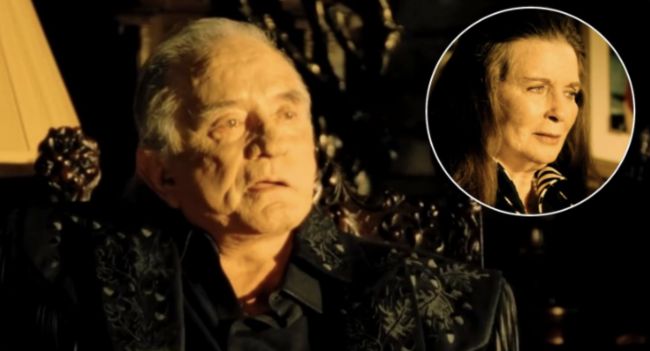
It seems an unlikely pairing: an ailing country legend interpreting a stark alternative-rock song written by Nine Inch Nails’ Trent Reznor. Producer Rick Rubin suggested that Johnny Cash record “Hurt,” although Cash was initially uncertain that the song suited him. His deeply personal version appeared on the 2002 album American IV: The Man Comes Around. After hearing the recording, director Mark Romanek pleaded for the opportunity to make its music video and even offered to work without a fee. The result became far more than a conventional promotional film, emerging as a powerful meditation on memory, regret and mortality
Filmed in February 2003, when Cash was 71, the video used his lakeside home and the long-closed, flood-damaged House of Cash museum in Hendersonville, Tennessee. The museum’s deteriorating condition provided a haunting visual reflection of Cash’s frailty and fading past. Romanek surrounded him with religious imagery, neglected memorabilia and an elaborate banquet that gradually becomes disordered as Cash pours wine across the table. Images of awards and gold records underscore the contrast between his extraordinary achievements and the impermanence of worldly success. Editor Robert Duffy also intercut footage of the younger Cash, creating a heartbreaking contrast with the visibly fragile man performing the song decades later.
Cash’s physical frailty was painfully real rather than something created for the camera. The video also includes brief appearances by his wife, June Carter Cash, whose watchful expression adds another deeply moving dimension to the performance. For many viewers, the film now feels like Cash’s final farewell, although neither he nor Romanek could have known precisely how soon tragedy would follow. The closing image of Cash shutting the piano lid has frequently been interpreted as symbolising the end of his career or the closing of a coffin, but that remains an interpretation rather than a confirmed explanation. June died on May 15, 2003, and Johnny followed on September 12 that year.
Cash’s performance gave Reznor’s composition an entirely different emotional perspective. As one admirer observed, Reznor’s recording can sound like a younger man confronting self-destruction, while Cash’s feels like an older man examining his life, losses and regrets. Reznor was initially uneasy about someone else interpreting such a personal song, but the completed video changed his response. He recalled being deeply affected by its sincerity and power, eventually concluding: “Wow. I just lost my girlfriend, because that song isn’t mine anymore.” To appreciate how dramatically Cash transformed the composition, viewers can also revisit Nine Inch Nails’ stark original recording.
The video’s critical reception was monumental. Cash was still alive when “Hurt” won Best Cinematography at the MTV Video Music Awards in August 2003, although he did not live to see it receive the 2004 Grammy for Best Short Form Music Video. It also won Music Video of the Year at the 2003 CMA Awards. In 2005, a poll conducted for Britain’s The Hits television channel placed “Hurt” ahead of Michael Jackson’s “Thriller” as the greatest music video ever made. Its emotional power continues to resonate with older viewers in particular, including one 71-year-old who wrote that the song becomes increasingly profound as a person draws closer to the end of life.
The physical locations associated with the video have experienced their own losses. Cash and June’s lakeside home was purchased by Bee Gees singer Barry Gibb and his wife Linda in 2006, but it burned to the ground during renovation work in April 2007. The House of Cash museum seen elsewhere in the video was a separate building and was later demolished. The chair in which Cash sat during filming has reportedly been displayed at the modern Johnny Cash Museum in Nashville. More than two decades later, Romanek’s film remains an extraordinary portrait of vulnerability—a final, unguarded encounter with an artist confronting memory, faith, regret and the approaching end of his life.