When The Beatles officially split in 1970, the break had already been taking shape for years. Each member had been preparing for life after the band, and George Harrison was more than ready to step out on his own. During the final stretch of The Beatles, he had built up a large collection of songs that never found space on the group’s albums. Once the band ended, those songs finally had a home.
Harrison’s first solo release after the breakup was All Things Must Pass, a bold triple album that arrived in 1971. It became a major success and made him the first former Beatle to score a No. 1 album in the aftermath of the split. The record opens quietly with “I’d Have You Anytime,” a gentle love song credited to Harrison and Bob Dylan. While many listeners assumed it was romantic in the usual sense, the song was shaped by something deeper: a close friendship between two artists who trusted each other completely.
View this post on Instagram
A Bond Formed in the 1960s
George Harrison first met Bob Dylan in 1964, when The Beatles toured the United States for the first time. The band admired Dylan’s writing, and his influence soon reached them on a personal level as well. In The Beatles Anthology, the group later shared that Dylan introduced them to marihuana, a moment that became part of music history. Over time, Dylan also grew fond of The Beatles, but his strongest connection was with Harrison.
Their personalities fit together with ease. Harrison admired Dylan’s honesty, while Dylan respected Harrison’s quiet focus and spiritual side. As the 1960s went on, their friendship deepened through shared music, long talks, and mutual respect. They were not competing with each other; instead, they listened, learned, and supported one another during a fast-changing time in popular music.
By late 1968, Harrison was spending more time in the United States. He was producing an album for one of Apple Records’ early signings and had been working in Los Angeles for several months. Around Thanksgiving, Dylan invited him to stay at his home in Woodstock, New York. The visit gave the two musicians rare time away from pressure and expectations.
Writing a Song From Concern
Although they played music together and enjoyed each other’s company, Harrison noticed something was off. Dylan was still recovering from injuries linked to his motorcycle accident, and his mood reflected that struggle. Seeing his friend withdrawn left a strong impression on Harrison and soon led to the start of a song.
Harrison began writing what would become “I’d Have You Anytime” and later invited Dylan to help finish it. The lyrics read like an open door, offering comfort and patience. The opening line sets the tone: “Let me in here, I know I’ve been here, let me into your heart.” Rather than pushing, the words ask gently for trust and closeness.
In the chorus, the feeling becomes even clearer. “All I have is yours, all you see is mine. And I’m glad to hold you in my arms, I’d have you anytime.” The song does not rush or demand. It reassures. It promises presence during difficult moments, and it reflects how Harrison felt about Dylan during that period of his life.
A Friendship That Lasted
When All Things Must Pass reached listeners in 1971, “I’d Have You Anytime” served as a soft but meaningful opening statement. Still, it was far from the end of Harrison and Dylan working together. Over the years, they appeared on each other’s projects and shared stages in different settings.
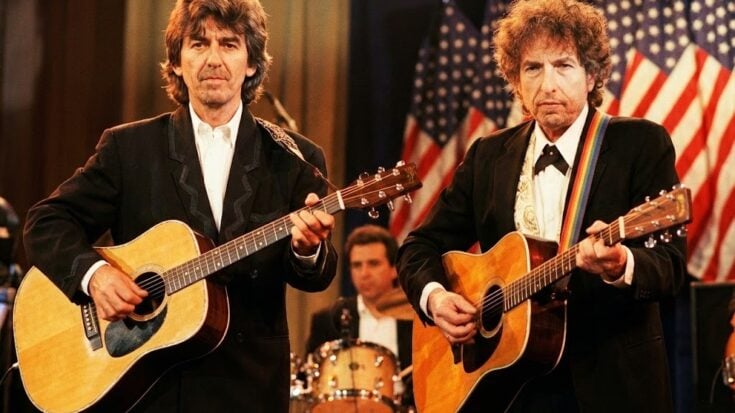
In 1988, their bond took a public form when they joined forces in the Traveling Wilburys, alongside Tom Petty, Roy Orbison, and Jeff Lynne. The group released successful records and reminded fans that collaboration could still feel loose and joyful. After Orbison’s death, the remaining members stayed in touch, and Harrison and Dylan remained especially close.
Their friendship was later discussed in Martin Scorsese’s documentary George Harrison: Living in the Material World. Harrison’s widow, Olivia Harrison, spoke openly about what the relationship meant to her husband. She described it as one of “George’s most important relationships.”
“I mean, George… ‘I’d Have You Anytime,’ the song that George and Bob wrote together. He was talking directly to Bob because he’d seen Bob, and then he’d seen Bob another time and he didn’t seem as open. And so, that was his way of saying, ‘Let me in here. Let me into your heart.’”
She added that Harrison “was very unabashed and romantic” when it came to his friendships. “You know, I found that he had these love relationships with his friends. He loved them.”
Support Behind the Music
That openness shaped how All Things Must Pass came together. Harrison leaned on people he trusted as he stepped forward as a solo artist. Bob Dylan’s role in “I’d Have You Anytime” mattered, but so did Eric Clapton’s presence. Clapton played guitar on the track, adding another layer of familiarity and support.
Years later, Harrison reflected on why that song felt right as the album’s opening moment. “Subconsciously, I needed a bit of support. I had Eric playing the solo, and Bob had helped write it, so it could have been something to do with that,” Harrison said in one of his final interviews in 2001.