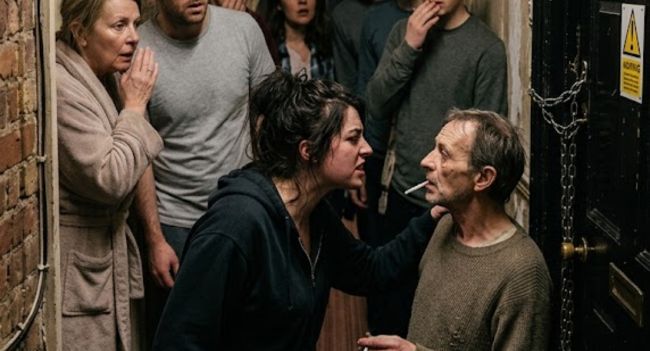
THE TENANT IN FLAT 4B
The first time I heard the woman crying, it was 2:17 in the morning.
I had been living at Blackwood House for exactly four nights.
The building stood at the end of a narrow London street, squeezed between a closed bookshop and a church that no longer held services. It was an old place with dark brick walls, narrow staircases, and windows that rattled whenever the wind rose.
The rent was suspiciously cheap.
I should have asked why.
Instead, I signed the lease before the landlord could change his mind.
As a university student with almost no money, I considered peeling wallpaper and unreliable heating a fair price for living twenty minutes from campus.
My flat was 4A.
Flat 4B was directly across the hall.
Its door was painted black and secured with a thick silver chain.
On my first day, I assumed the tenant was away.
On my fourth night, I realised someone was inside.
The crying began as a faint sound behind the wall.
At first, I thought it was the wind.
Then I heard a woman whisper.
“Please.”
I sat up in bed.
The voice came again.
“Please help me.”
I crossed the room and pressed my ear against the wall.
The crying stopped.
For several seconds, there was only silence.
Then three violent knocks struck the other side.
I jumped back.
“Hello?” I called.
No answer.
I stepped into the hallway and stared at the black door of Flat 4B.
The chain hung across it.
I raised my hand to knock.
Before my fingers touched the wood, a woman screamed from inside.
“Don’t open the door!”
I stumbled backward.
A light flickered beneath the door.
Then everything went dark.
The next morning, I found the building manager in the lobby.
Mr. Finch was a thin man in his sixties who always smelled faintly of cigarettes and furniture polish.
“There’s someone living in Flat 4B,” I told him.
The colour left his face.
“No.”
“I heard her last night.”
“You heard the pipes.”
“The pipes didn’t ask me for help.”
He glanced toward the staircase.
“Flat 4B is empty.”
“Then why is it chained?”
Mr. Finch hesitated.
“That flat has been sealed for ten years.”
I laughed because I thought he was joking.
He wasn’t.
“A young woman lived there,” he continued. “A student. Her name was Evelyn Shaw. One night, she disappeared.”
“Disappeared?”
“The police searched the building. They found no sign of her. Her door was locked from the inside, but she was gone.”
“And nobody has entered since?”
“The landlord didn’t want trouble. The flat was sealed.”
I stared at him.
“I heard someone.”
Mr. Finch stepped closer and lowered his voice.
“People sometimes hear things in old buildings. Do yourself a favour, Miss Carter. Ignore them.”
Then he walked away.
That evening, I searched for Evelyn Shaw online.
There were only a few old newspaper articles.
LONDON STUDENT VANISHES FROM LOCKED FLAT
Evelyn had been twenty-three years old. She studied physics at the same university I attended.
The photograph accompanying the article showed a pale young woman with dark hair and serious eyes.
I stared at the picture for a long time.
Something about her face felt familiar.
At 2:17 that morning, the crying began again.
This time, I was waiting.
I sat beside the wall with my phone recording.
“Evelyn?” I whispered.
The crying stopped.
A woman inhaled sharply.
“How do you know my name?”
My blood turned cold.
“You’re Evelyn Shaw?”
“Yes.”
Her voice shook.
“What year is it?”
I almost laughed.
“What?”
“Tell me the year.”
“It’s 2026.”
A long silence followed.
“No,” she whispered. “No, that’s impossible.”
“What year do you think it is?”
“2016.”
I stared at the wall.
“This isn’t funny.”
“I’m not joking!” she shouted. “I’ve been trapped in this room for three days.”
“You’ve been missing for ten years.”
She began to sob.
I forced myself to stay calm.
“What happened to you?”
“I was working on an experiment.”
“What kind of experiment?”
“A device that could transmit sound through time.”
I looked at my phone.
The screen was still recording, but the timer was frozen at 2:17.
Evelyn continued.
“It wasn’t supposed to affect anything physical. It was only meant to send a voice a few seconds into the past.”
“But something went wrong.”
“The machine overloaded. The door disappeared. The windows disappeared. I can still see the room, but I can’t leave it.”
She struck the wall.
The sound came from directly beside my head.
“I’m still here, but not in your time.”
I wanted to believe it was a cruel joke.
Then Evelyn said something that made my skin prickle.
“There’s a crack shaped like a lightning bolt above your bed.”
I turned.
The crack was there.
It had been hidden behind a framed picture until I removed it that afternoon.
There was no possible way she could have known.
“How can I help you?” I asked.
“Find the machine.”
“Where?”
“In my flat.”
“The door is locked.”
“You have to open it.”
I remembered the scream from the previous night.
“You told me not to.”
“That wasn’t me.”
The hallway light outside my flat suddenly went out.
Evelyn’s voice dropped to a whisper.
“Someone else is listening.”
The next day, I stole the key to Flat 4B from Mr. Finch’s office.
I told myself I was borrowing it.
The key slid into the lock, but the door would not move until I removed the chain.
Behind it, the air smelled of dust and burnt metal.
Flat 4B had been frozen in time.
A half-empty cup stood on the kitchen table. Books covered the floor. A wool coat hung beside the door.
On the wall was a calendar from October 2016.
I walked into the bedroom.
A complicated machine occupied the desk. Copper wire wrapped around two metal rings. A cracked digital clock was connected to a small cassette recorder.
The clock displayed one time.
2:17.
Beside the machine lay a notebook.
Most of the pages were filled with equations I could not understand.
The final page contained only four words:
DO NOT TRUST LENA CARTER.
My name.
Written ten years before I moved into the building.
I dropped the notebook.
A floorboard creaked behind me.
Mr. Finch stood in the doorway.
“You should not have come in here,” he said.
I stepped away from him.
“Why is my name in her notebook?”
Mr. Finch looked exhausted rather than surprised.
“Because this has happened before.”
“What has?”
“You.”
He closed the door.
“Every ten years, a young woman named Lena Carter rents Flat 4A. Every time, she hears Evelyn. Every time, she tries to save her.”
“That’s impossible.”
“The first Lena disappeared in 2006.”
My mouth went dry.
“Evelyn disappeared in 2016.”
“She was not the first Evelyn.”
He pointed toward the machine.
“That device does not send sound through time. It creates a loop. Evelyn hears you in her future. You hear Evelyn in your past. Each of you tries to rescue the other.”
“What happens when the machine is activated?”
Mr. Finch’s face tightened.
“The two times exchange places.”
I stared at him.
“Evelyn returns.”
“And I disappear.”
“Yes.”
“Why didn’t you destroy it?”
“I tried. Every time I did, it appeared again.”
The digital clock began to flicker.
2:16.
Mr. Finch looked at it in horror.
“She’s activating it.”
A low hum filled the room.
The metal rings started turning.
From the wall came Evelyn’s voice.
“Lena, are you there?”
I moved toward the machine.
Mr. Finch grabbed my arm.
“If you turn it off, she stays trapped.”
“And if I leave it on?”
“You take her place.”
The clock changed.
2:16:30.
Thirty seconds.
“Why did she write that I shouldn’t trust myself?” I asked.
Mr. Finch looked at the notebook.
“She didn’t.”
The handwriting began to change before my eyes.
The black ink faded.
New words appeared across the page.
DO NOT TRUST FINCH.
I turned.
Mr. Finch was holding a knife.
“I’m sorry,” he said.
The sadness vanished from his face.
“I’ve waited ten years for this.”
He lunged.
I threw myself aside.
The knife struck the desk.
The machine shook violently.
The metal rings spun faster.
2:16:45.
Mr. Finch seized my hair and dragged me toward the centre of the room.
“You don’t understand,” he hissed. “I was the one who built the machine. Evelyn stole my research. When she vanished, everyone blamed me.”
“You trapped her!”
“I only wanted her to return.”
“By sacrificing me?”
“Someone must take her place.”
I drove my elbow into his ribs.
He loosened his grip.
I grabbed the cassette recorder and smashed it against the edge of the desk.
The hum stopped.
For one second, everything became silent.
Then the clock jumped to 2:16:58.
Two seconds.
Evelyn screamed through the wall.
“Lena, break the clock!”
Mr. Finch threw himself at me.
I reached for the digital clock.
His fingers closed around my wrist.
2:16:59.
I pulled free and slammed the clock onto the floor.
The display shattered.
At exactly 2:17, the room exploded with white light.
I woke on the floor.
Sunlight streamed through the bedroom window.
The machine was gone.
So was Mr. Finch.
A woman lay beside me.
She had dark hair and serious eyes.
Evelyn Shaw opened them slowly.
For several seconds, we stared at each other.
“What year is it?” she whispered.
“2026.”
She began to cry.
This time, they were tears of relief.
The police found Mr. Finch unconscious inside a hidden room beneath the building. The walls were covered with photographs, newspaper clippings, and notes about every previous cycle.
He had spent decades recreating the experiment, waiting for the exact conditions that would bring Evelyn back.
The machine’s destruction broke the loop.
At least, that was what we believed.
Evelyn had lost ten years without ageing a day. The world she returned to was almost unrecognisable, but she learned quickly.
Three months later, she moved into a small flat near mine.
We became friends.
Sometimes, late at night, we talked about the things that had happened inside Blackwood House.
Neither of us ever returned to the fourth floor.
The building was eventually condemned.
On the day it was demolished, Evelyn and I stood across the street and watched the walls collapse.
For the first time in ten years, Flat 4B was open to the sky.
I thought it was finally over.
Then my phone vibrated.
An audio file had appeared on the screen.
There was no sender.
The recording was only four seconds long.
I pressed play.
My own voice whispered through the speaker.
“Lena, don’t let Evelyn see the notebook.”
I looked at Evelyn.
She was already staring at me.
In her hands was a black notebook I had never seen before.
She opened it to the final page.
Written there, in fresh black ink, were six words:
THE LOOP DID NOT BEGIN WITH FINCH.