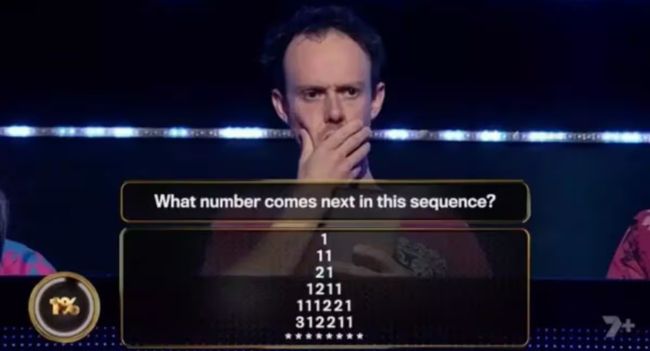
The 1% Club Finalists Wiped Out by a Brutal Sequence Question — And Not One Player Could Crack It in 30 Seconds

A group of finalists on the Australian version of The 1% Club made it all the way through the competition, only to encounter a final puzzle so difficult that every remaining contestant failed.
The show follows the same basic format as its UK counterpart: 100 contestants work through increasingly challenging questions designed to test logic rather than traditional general knowledge.
With a potential $100,000 prize on the line, the remaining players faced one last sequence.
They had only 30 seconds to understand it.
Nobody succeeded.
The Final Sequence Looked Almost Meaningless

Host Jim Jefferies presented the contestants with the following numbers:
1, 1, 1, 2, 1, 1, 2, 1, 1, 1, 1, 1, 1, 2, 2, 1, 3, 1, 2, 2, 1, 1
The challenge sounded simple: determine what should come next.
But the numbers offered no obvious mathematical progression.
As the timer dropped from 30 seconds to 15 and eventually the final five, the contestants continued searching for the hidden rule.
For the first time in the episode, none of the remaining players managed to produce the correct answer.
Then Jefferies revealed it:
The seemingly random string suddenly made sense once the unusual pattern was explained.
The Trick Was to Describe What You Could See

The sequence was not based on conventional arithmetic.
Instead, players needed to read the previous numbers and describe them in groups.
The pattern works by counting consecutive identical digits — effectively describing what appears directly before the next part of the sequence.
That leads to the final answer being expressed as one three, one one, two twos and two ones — producing 13112221.
Once the explanation was shown, the logic became much easier to follow.
Recognizing it from scratch in only 30 seconds was another matter entirely.
Jefferies reacted to the complete wipeout with sympathy after realizing that nobody had solved the final challenge.
Viewers Thought 30 Seconds Made It Particularly Brutal
The puzzle subsequently attracted attention online, where viewers debated whether they could realistically have spotted the pattern under the same pressure.
Some argued that anyone already familiar with this style of sequence would have had a significant advantage.
For someone encountering it for the first time, however, finding the rule and applying it correctly within half a minute was considered far more difficult.
That distinction is exactly what makes The 1% Club’s hardest questions so effective.
Once an answer is explained, it can appear surprisingly logical.
Before the reveal, it can look almost impossible.
The Format Rewards Logic Rather Than General Knowledge
Unlike conventional quiz shows, The 1% Club does not primarily reward contestants for memorizing facts.
The questions are designed around reasoning, patterns, language and lateral thinking, with each stage becoming progressively more difficult.
That means even strong contestants can suddenly find themselves stuck when a problem requires them to abandon the most obvious interpretation.
The Australian finalists experienced exactly that.
They had survived enough questions to reach the decisive stage, but one strange row of ones, twos and threes was enough to stop every one of them.
And perhaps the most frustrating part was that once 13112221 appeared on screen and the pattern was explained, the impossible-looking puzzle suddenly seemed much simpler than it had just seconds earlier.